I have been tracking gold markets for years. And I want to be completely honest with you right now:
What is happening to gold prices in 2026 is not a blip. It is not speculation. It is not hype.
It is the result of nine massive forces — all hitting at the same time — each one pushing gold higher than the last. Some of them you know about. Some of them, I guarantee, you have never heard before.
By the time you finish reading this, you will understand gold prices better than 99% of people around you. And you will know exactly what happens next.
Let’s go.
 Force #1: The War Premium — How Global Conflicts Are Secretly Taxing Every Indian Buyer
Here is a fact that most gold analysts in India never say out loud:
Every active war zone in the world adds a “fear tax” to your gold price.
And right now, the world is running more active conflict zones simultaneously than at any point since World War II.
Think about what is happening as you read this:
Russia-Ukraine War (Year 4): Still no end in sight. Europe is rearming at record speed. NATO nations are spending over $1.3 trillion on defense in 2025 alone. When governments spend this kind of money on weapons, they stop trusting paper money and stock markets. They buy gold.
Middle East Escalation: The Israel-Hamas-Hezbollah-Iran axis of conflict has kept the entire Middle East on edge. The Red Sea shipping disruptions alone raised global inflation. Gold loves inflation.
China-Taiwan Tensions: This is the one that keeps institutional investors up at night. The moment this situation escalates even slightly, gold will spike within hours. We saw this during every Taiwan Strait incident in 2024 and 2025.
India-Pakistan Border Tensions: This one directly affects Indian gold buyers. Whenever India-Pakistan relations deteriorate, domestic demand for gold — as a store of value independent of government decisions — spikes in border states and across North India.
Sudan and Sub-Saharan Africa conflicts: These disrupt gold mining regions. Supply goes down. Prices go up.
Here is the pattern that has played out repeatedly throughout human history: When bullets fly, gold rises. When governments feel unsafe, they stop holding other currencies and start holding gold. When ordinary people feel unsafe, they do the same.
Gold remains at the centre of a global financial storm driven by war, political instability, and a massive re-evaluation of the US dollar.
The world is not becoming safer. That means gold is not becoming cheaper.

 Force #2: The Number That Changed Everything — Gold Hit $5,595 in January 2026
Let us look at the raw numbers for a second, because they are genuinely staggering.
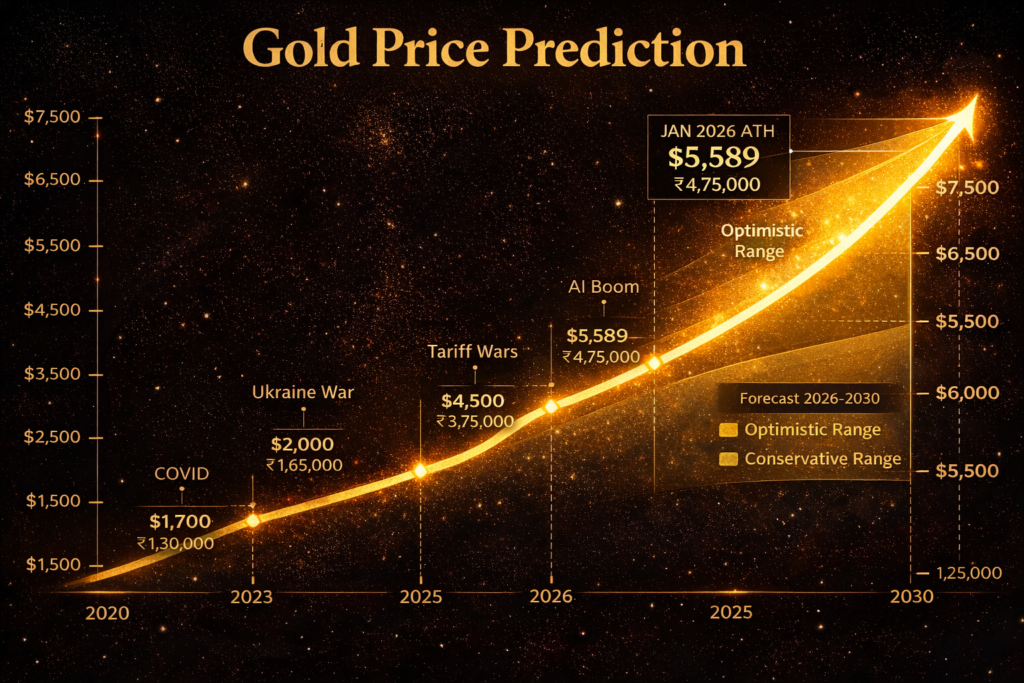
Gold’s all-time high now stands at $5,589.38 per ounce, a record reached on January 28, 2026.
To understand how extraordinary this is, consider the journey:
- January 2025: Gold at $2,624 per ounce
- April 2025: Broke $3,500 amid tariff chaos
- Late 2025: Surged past $4,500
- January 28, 2026: Hit $5,589 — an all-time record
In just 12 months, gold didn’t just set new highs — it redefined what a “high” gold price looks like in the modern market.
In India, this translated directly to rupee prices. With the rupee simultaneously weakening against the dollar, Indian buyers felt a double hit — the dollar price of gold rose AND the rupee could buy fewer dollars to buy that gold.
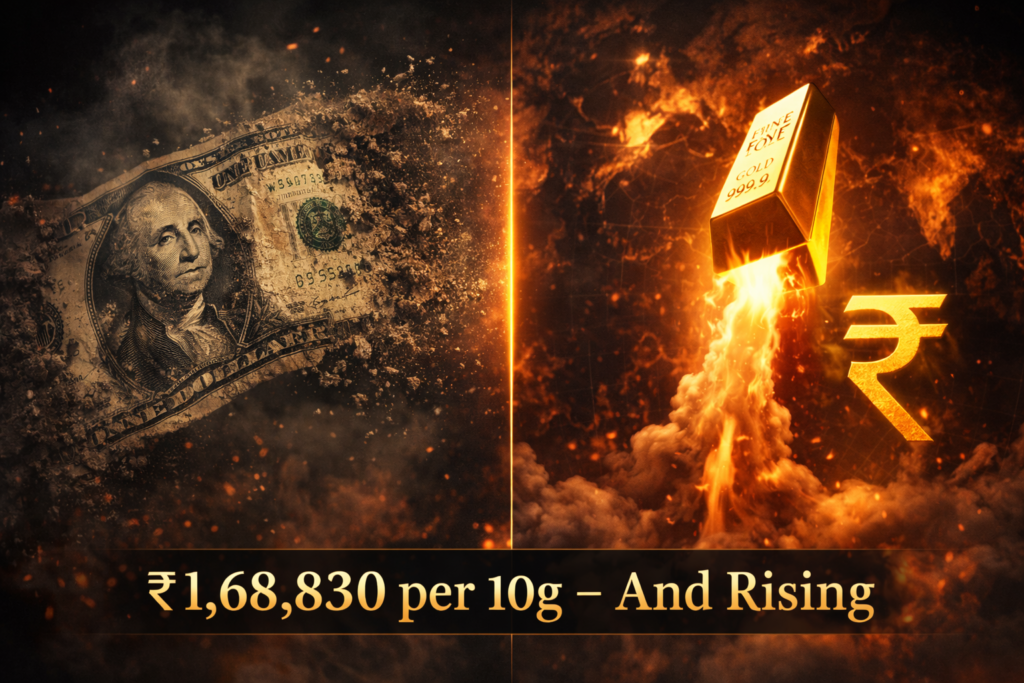
Today, as of March 2, 2026, gold in India stands at approximately ₹1,68,830 per 10 grams (24K) — a level that most Indian analysts thought was 3 to 4 years away, just 18 months ago.
In 2025, gold set 53 new all-time highs during the year — nearly one per week. That is not a market behaving normally. That is a market being driven by something fundamental.
 Force #3: Governments Are Buying Gold Secretly — And It’s Massive
Total global gold demand in 2025, including OTC, exceeded 5,000 tonnes for the first time — an unprecedented value of $555 billion, a 45% jump from the previous year.
The biggest driver of this? Governments.
Central bank and investor demand for gold is projected to average around 585 tonnes a quarter in 2026, with around 755 tonnes of central bank purchases expected for the full year.
Who is buying?
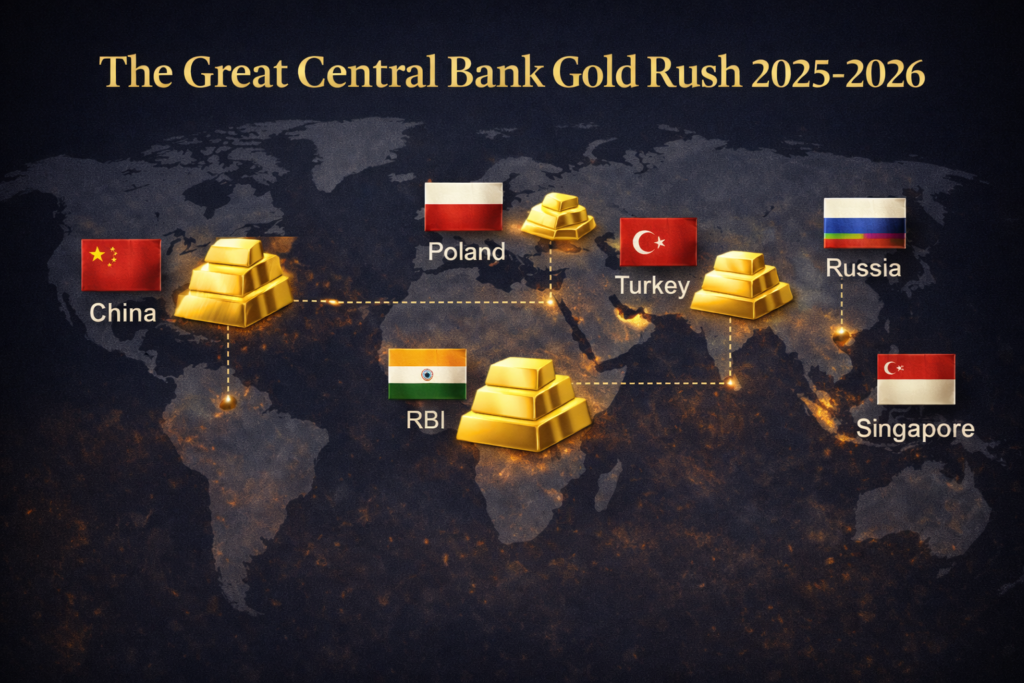
China has been the most aggressive buyer. The People’s Bank of China has been adding to reserves for consecutive months, pursuing a clear strategy: reduce dependence on the US dollar. As US-China trade tensions escalate, this strategy is only accelerating.
India’s RBI has been quietly one of the biggest buyers too, adding to reserves that now stand at record levels. When your own central bank is buying gold, that is the most powerful vote of confidence the metal can receive.
Poland, Turkey, Kazakhstan, Singapore, and several Gulf nations are also loading up. The pattern is clear: countries that once trusted the US dollar as a safe reserve are quietly replacing a portion of those reserves with gold.
Why does this matter for your gold rate today? Because central banks do not trade in and out of positions like retail investors. They buy and hold. This removes large quantities of gold from the market permanently — tightening supply against rising demand. Basic economics then does the rest.
 Force #4: The Shocking New Demand — Gold in Your AI Chips, Fighter Jets, and Satellites
This is the section I promised you had never seen before. Stay with me.
Gold is not just jewellery and investment bars. It is a critical industrial material — and demand from technology sectors is quietly creating an entirely new layer of gold consumption.
Gold in Electronics and AI Hardware
Every smartphone contains approximately 0.03 grams of gold. Seems tiny — until you multiply it by 1.5 billion smartphones manufactured every year.
AI data centers — the massive facilities being built across the US, Europe, India, and Asia to power ChatGPT, Gemini, Claude, and hundreds of other AI applications — use gold in their circuit boards, connectors, and processing chips because gold is the best electrical conductor that does not corrode.
The AI boom of 2024 and 2025 has translated directly into gold demand for technology manufacturing. And this demand is structural — it grows every year as AI adoption expands.
Gold in Defence and Weapons Manufacturing
Here is where it gets even more interesting.
The global defense spending surge driven by the Russia-Ukraine war and rising geopolitical tensions has created enormous new demand for gold in military hardware.
Precision-guided munitions (smart bombs), radar systems, satellite communication equipment, aircraft avionics, and electronic warfare systems all require gold-coated contacts and connectors for reliability in extreme conditions.
World military expenditure reached $2.718 trillion in 2024 — the steepest year-on-year rise since at least 1988. This is not just spending on soldiers and tanks. Much of this goes into high-tech weapons systems that contain significant quantities of gold.
As Europe rearmed after Russia’s invasion of Ukraine, as the US modernised its military technology, and as India increased its own defense budget to historic levels, the invisible demand for gold in defense manufacturing grew quietly but steadily.
Gold in Space and Satellites
The global space economy reached $613 billion in 2024. Every satellite launched into orbit — whether by ISRO, SpaceX, or OneWeb — contains gold. Gold reflects infrared radiation, making it ideal as a coating on satellite components to regulate temperature in the extreme cold of space.
India’s ambitious space program, combined with a surge in private satellite launches globally, has added yet another demand stream that simply did not exist a decade ago.
When you add electronics + AI hardware + defence + space together, you get a demand layer that is invisible to most gold buyers and analysts — but very real, very large, and very consistent.

 Force #5: The Dollar Is Crumbling — And That Directly Raises Your Gold Price
A weakening US dollar, sticky inflation, and increased safe-haven gold demand have all been tailwinds for gold, alongside economic and geopolitical turmoil caused by tariff policies.
Gold is priced globally in US dollars. When the dollar weakens, it takes more dollars to buy the same gold — so the dollar price rises. This increased demand further pushes prices up.
In 2025, the US Dollar Index dropped nearly 8%. Why?
Tariff Wars: The Trump administration threatened or enacted tariffs on many countries, including blanket tariffs on longtime US allies Canada and Mexico, tariffs on the EU, and 25% tariffs on all steel and aluminum imports. This rattled global confidence in the US as a stable trading partner.
US Debt Crisis: The US national debt crossed $36 trillion. Interest payments alone now consume over $1 trillion annually. When the world’s largest economy is this indebted, its currency becomes less attractive as a reserve.
BRICS Dedollarization: The BRICS nations — Brazil, Russia, India, China, South Africa, and their new members — are actively building trade systems that bypass the US dollar. Every step away from the dollar is a step toward gold.
For Indian buyers, this creates a painful double-squeeze: the dollar gold price rises (due to dollar weakness) AND the rupee weakens against the dollar simultaneously. Both forces push domestic gold prices in the same direction — upward.
 Force #6: The Crypto-Gold Revolution — Tether and Stablecoins Are Now Major Gold Buyers
This is 2026’s most surprising new development — and almost no Indian gold analyst is talking about it.
A powerful new wave of buyers has emerged from the cryptocurrency world. Tether, the largest among them, now holds the world’s largest known reserves of bullion outside of banks and actual countries.
These companies are using gold to diversify the dollars flowing through their stablecoin businesses and to back gold-linked digital tokens. By holding physical metal, they aim to anchor digital products to an asset seen as tangible, neutral and outside the traditional banking system.
Digital gold tokens — where each token is backed by a physical gram of gold — are exploding in popularity globally. Platforms creating these tokens must buy and hold physical gold for every token issued. This creates a demand stream that grows every time someone buys a digital gold token.
In India, digital gold via UPI platforms (PhonePe, Google Pay, Paytm Gold) has become mainstream. Millions of Indians who would never visit a jewellery store are now buying fractions of a gram digitally every month. This micro-demand, aggregated across millions of users, is a real and growing factor.
 Force #7: India’s Own Insatiable Hunger for Gold
No discussion of gold prices in India is complete without acknowledging India’s unique role in the global gold story.
India consumes approximately 700 to 900 tonnes of gold every year. We are the second-largest gold consuming nation on earth. And unlike most countries, our demand has two distinct engines:
The Cultural Engine: Weddings. Dhanteras. Akshaya Tritiya. Gold gifting at births, graduations, religious ceremonies. Gold as streedhan — a woman’s financial security independent of her husband’s income. This cultural demand is not price-sensitive. When gold gets expensive, wedding gold budgets are cut or spread over time — but they are never eliminated.
The Investment Engine: Investment volumes in gold reached 2,175 tonnes globally in 2025. Demand for gold bars and coins climbed to 1,374 tonnes, while inflows into gold ETFs increased to 801 tonnes. In India specifically, gold ETF inflows hit record highs, with millions of new investors — many of them first-time — buying their first gold investment digitally.
This new generation of Indian investors treats gold the same way their parents treated fixed deposits — as a non-negotiable part of the savings portfolio. And they are buying it monthly through SIP-style digital purchases, which creates a consistent, predictable demand floor that keeps prices supported even during short-term corrections.

 Force #8: Supply Is Being Squeezed From Every Direction
While demand is exploding from multiple directions simultaneously, supply has hit a wall.
Global gold mine production reached approximately 3,670 tonnes in 2025 — barely higher than the year before. There are no major new gold deposits being discovered. Existing mines are getting deeper, more expensive, and more environmentally complex to operate.
The cost of mining each ounce of gold has risen from around $900 in 2010 to over $1,600 today. That rising floor cost means gold cannot fall below a certain level without making mining economically unviable — effectively creating a price floor that rises every year.
Additionally, key gold-producing regions — parts of sub-Saharan Africa, Sudan, and conflict zones in Central Asia — have faced supply disruptions from ongoing conflicts. The same wars that increase investment demand for gold also disrupt the supply of newly mined gold. A perfect storm for higher prices.
 Force #9: Interest Rates Falling Globally = Gold’s Moment
Gold pays no interest. No dividend. No yield. This is its “weakness” — but only when alternatives pay something meaningful.
When the US Federal Reserve and central banks globally kept rates at 5%+, holding gold had an “opportunity cost.” Why hold gold when you could earn 5% on a government bond?
But now that rates are falling — and falling fast — that opportunity cost is disappearing. After the explosive demand-led surge seen throughout 2025, investor and central bank gold demand is set to remain strong in 2026, averaging 585 tonnes a quarter.
In India, lower FD rates have the same effect. When your fixed deposit gives you 6.5% instead of 8%, gold — which gave 40%+ returns in 2025 — looks extraordinarily attractive by comparison.
This is not coincidence. It is a pattern that has repeated consistently across multiple decades: the first 18 months after a rate-cutting cycle begins is almost always golden (pun very much intended) for gold prices.
 GOLD PRICE PREDICTION TABLE: 2026 — 2030
Based on JP Morgan, Goldman Sachs, World Bank, VanEck, and LiteFinance analyst data. These are projections, not guarantees.
Year | Global Price (USD/oz) | India Price (₹/10g 24K) | Key Driver |
2026 (Current) | $5,000–$5,600 | ₹1,50,000–₹1,72,000 | War premium + Central banks |
2026 (Year End) | $5,400–$6,000 | ₹1,72,000–₹1,95,000 | Rate cuts + ETF inflows |
2027 | $5,800–$7,000 | ₹1,90,000–₹2,30,000 | Dedollarization accelerates |
2028 | $6,500–$8,500 | ₹2,10,000–₹2,80,000 | BRICS reserve buying peaks |
2029 | $7,000–$10,000 | ₹2,30,000–₹3,30,000 | Rupee depreciation factor |
2030 | $8,000–$15,000+ | ₹2,60,000–₹5,00,000+ | Long-term structural shift |
Forecasts for the XAU/USD rate for 2026 are bullish, with the asset likely trading in the $5,709–$7,031 range. According to more optimistic forecasts, gold may surge to $10,762 by 2030.
J.P. Morgan’s forecast sees gold pushing toward $5,000/oz by Q4 2026, with $6,000/oz a possibility longer term.
Nicky Shiels, head of metals strategy at MKS PAMP, expects gold prices to reach $5,400 in 2026, noting the current cycle does not resemble a speculative peak.
Important caveat: These are projections based on current conditions. A major peace agreement in Ukraine, a dramatic reversal of US tariff policy, or a sharp rise in US interest rates could cause a significant correction. Gold is not a one-way bet — but the structural forces supporting it are stronger today than at any point in modern history.